Category: Smile Across America

  • Smile Across America: Local Volunteers Help Reopen a Safer Way to Root Glacier

    Smile Across America: Local Volunteers Help Reopen a Safer Way to Root Glacier

    Smile Across America

    At Alaska’s Root Glacier, a practical piece of community work has reopened a way for visitors to reach one of Wrangell-St. Elias National Park and Preserve’s signature landscapes.

    Editorial illustration of park trail workers and local volunteers standing together at the start of a rocky reroute, with an Alaska glacier in the distance.
    Editorial illustration

    Earlier this summer, park geologists found unstable ground and a possible landslide area on the moraine beside the Root Glacier access trail north of the Kennecott Mines National Historic Landmark. The National Park Service closed that section in July and began looking for a safer way around it.

    By August 3, park employees and local volunteers had established a new route. The work did not erase the hazard—the original area remains closed—but it did give visitors a way to continue toward the glacier while avoiding the unstable slope and the risk of falling rock.

    That distinction is what makes the update feel quietly generous. The new path is not a shortcut, nor a promise that mountain terrain will stand still. It is a route made with care for the people who come after: families, first-time visitors, longtime hikers and the neighbors who help keep this enormous park welcoming.

    Editorial illustration of four trail workers and volunteers clearing vegetation and improving a rocky footpath above an Alaska glacier.
    Editorial illustration

    A route built for the people behind it

    The Park Service says trail crews brushed vegetation and improved the walking surface where practical. The reroute begins 1.8 miles along the Erie Mine Trail: visitors go roughly ten yards beyond the Amazon Creek footbridge, turn left, then travel downhill about 0.6 miles to the glacier’s edge. In all, the route is about 2.5 miles one way to glacier access.

    Acting Superintendent Joshua Scott credited staff and volunteers for moving quickly to create the alternative. That is the people-first heart of this story: a group of workers and local helpers responding to a changing landscape with a useful, shared answer.

    Root Glacier is one of the park’s most visited destinations, and the new route preserves an experience many people travel a long way to have. The original closure, meanwhile, remains important. It is a reminder that a better route is also one that respects the forces already at work in glacial country.

    Editorial illustration of an intergenerational hiking group viewing an Alaska glacier from a marked rocky overlook at a safe distance.
    Editorial illustration

    Keep the welcome practical

    Visitors should expect uneven footing. The Park Service describes the route beyond the improved section as natural terrain with rocky glacial debris and muddy areas near the glacier’s edge. It recommends traction devices for anyone planning to step onto the ice and advises putting them on before reaching the steep glacier access point.

    Conditions in glacier and moraine landscapes can change quickly, so hikers should stay on the designated route, follow closure signs and check current conditions with the park or at the Kennecott Visitor Center before setting out.

    There is no grand ribbon-cutting in this story—just a closed route, people willing to do the careful work, and a new way forward. In a place shaped by moving ice and loose rock, that is a welcome worth noticing.

    Sources

  • Smile Across America: A Turtle Named Ivy Has Grandbabies, and a Community Cheered Them On

    Smile Across America: A Turtle Named Ivy Has Grandbabies, and a Community Cheered Them On

    Smile Across America: On a June evening in Concord, Massachusetts, a crowd gathered at Great Meadows National Wildlife Refuge for a small send-off with a very long backstory: two nine-month-old Blanding’s turtles were about to return to a wetland.

    The pair were not simply this year’s hatchlings. They are the first documented offspring of Ivy, a turtle who herself passed through the refuge’s headstart program years earlier. For the people who have spent decades protecting nests, raising hatchlings and watching the wetlands, it was a generational milestone measured in two small shells.

    Editorial illustration of conservation volunteers and children watching a biologist release a Blanding’s turtle into a summer wetland at sunset.
    Editorial illustration

    A community-sized head start

    Great Meadows’ program works by giving hatchlings a safer first winter. The U.S. Fish and Wildlife Service says the young turtles are placed with care facilities, including local schools, while they are still tiny; by spring, they are substantially larger and better able to survive. MassWildlife describes the classroom side of the work as part of Zoo New England’s HATCH program, which has involved more than 22,000 Massachusetts K–12 students since 2009.

    The June 25 release brought together Zoo New England, MassWildlife, the U.S. Fish and Wildlife Service, conservation partners and supporters. The two hatchlings were Ivy’s offspring, a fact that connects a 2026 release to a program that began at Great Meadows in 2003.

    Ivy’s own journey makes that connection tangible. After she was headstarted and returned to the refuge as a young turtle, she went unseen for years. Field technicians found her again during a 2023 survey. In 2025, conservationist Jimmy Welch tracked and protected her nest; it produced seven hatchlings. Some of the siblings were raised in local classrooms and released with students before the June gathering, according to the Fish and Wildlife Service.

    Editorial illustration of children, a teacher and a conservation worker observing a young yellow-throated Blanding’s turtle beside a wetland.
    Editorial illustration

    More than a release

    About 40 people came to the refuge to see the two turtles off, the Fish and Wildlife Service reported. The group included field technicians, animal-care specialists, volunteers, interns, retired teachers whose students had raised turtles, and nearby residents. It also honored Dr. Bryan Windmiller, who founded Zoo New England’s Blanding’s turtle conservation program at Great Meadows and retired this year.

    That mix of people matters because the turtles live in a busy landscape. They use wetlands and travel over land, so their future depends on careful habitat work, monitored nesting areas and neighbors who understand why a turtle may be crossing a road or using a nearby marsh. The partners deliberately avoid publicizing sensitive wild-turtle locations, a protection that lets the celebration stay joyful without making the animals more vulnerable.

    The payoff is not instant. Blanding’s turtles can live for decades, and long-term recovery asks for patience. But this evening offered a practical kind of optimism: a student’s winter classroom project, a technician’s field survey, a protected nest and a community’s attention all converged at the water’s edge.

    Editorial illustration of two young Blanding’s turtles swimming from a release tray into a reed-lined wetland at sunset while volunteers watch from shore.
    Editorial illustration

    The warmest kind of return

    At the end of the gathering, the conservation team waded into the wetland and released the next generation. For everyone who had helped make room for these turtles—in classrooms, on survey routes and around the refuge—the moment was a reminder that conservation can be personal without being possessive. Sometimes the happy ending is simply watching a small creature disappear into the place it belongs.


    Sources: U.S. Fish and Wildlife Service reporting by Bridget Macdonald, July 7, 2026; and MassWildlife’s July 1, 2026 release with Zoo New England and the U.S. Fish and Wildlife Service.

  • Smile Across America: A Three-Hour Invitation to Care for Yosemite Valley

    Smile Across America: A Three-Hour Invitation to Care for Yosemite Valley

    Smile Across America is a warm look at real ways communities care for the places they share. This stop is Yosemite Valley, where a few practical hours are on the calendar for August 18.

    Yosemite National Park is inviting people to a drop-in litter clean-up on Tuesday, August 18, 2026, from 10 a.m. to 1 p.m. The meeting point is in front of the Exploration Center in Yosemite Village. It is an unusually straightforward invitation: the park says volunteers can simply show up for these special events rather than complete an application in advance.

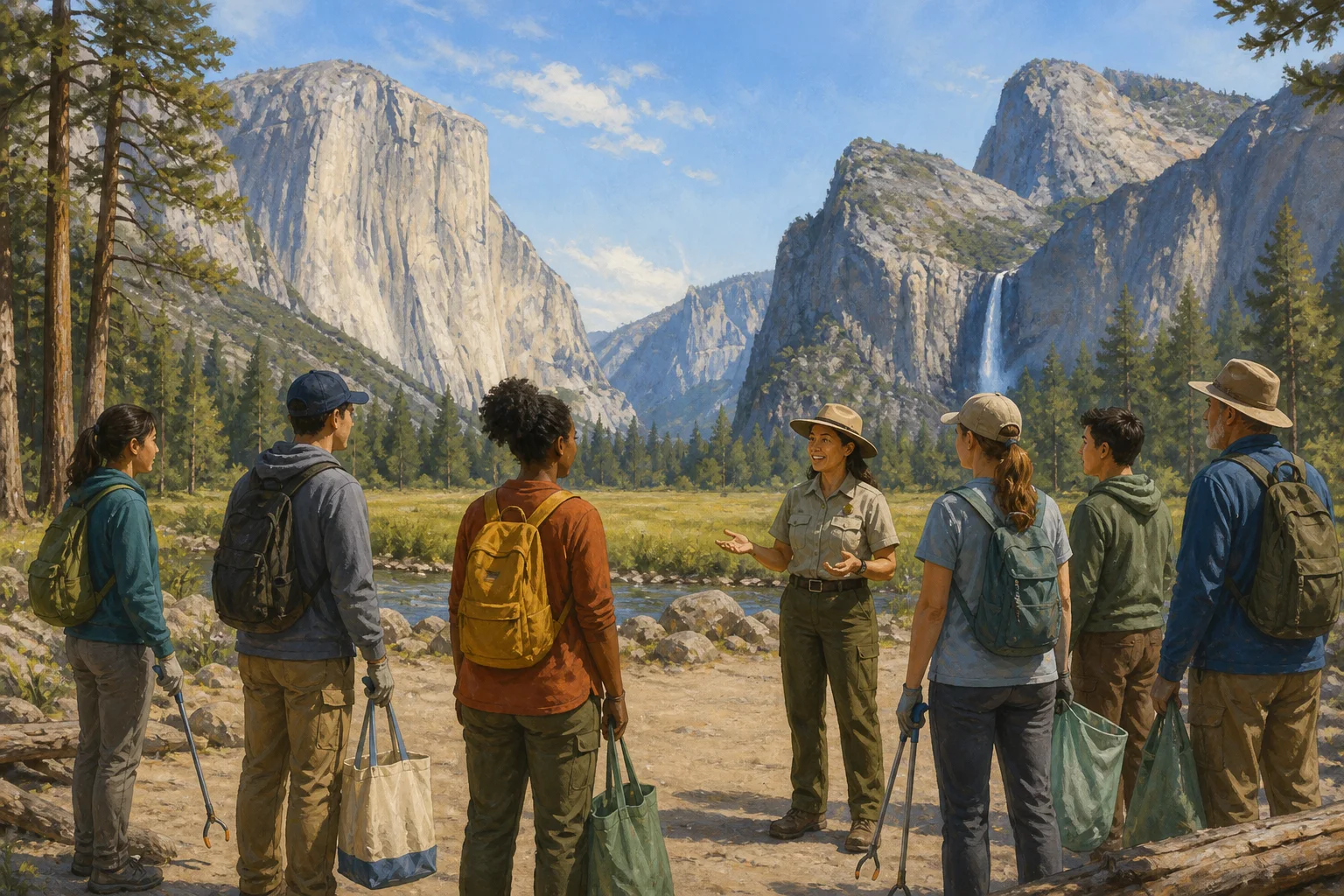
    Editorial illustration of volunteers gathering with a park leader in Yosemite Valley, with granite cliffs and a waterfall behind them.
    Editorial illustration

    A small window to pitch in

    Three hours is a manageable slice of a summer day, and the work has a clear purpose: helping keep Yosemite Valley looking beautiful. The National Park Service says the summer clean-up is one of several special events where people can join a hands-on project. Tools and protective equipment are provided.

    For anyone planning to take part, the park asks participants to wear long pants and closed-toe shoes suited to the weather, and to bring sun protection, water, and snacks. Everyone must sign a volunteer agreement; a guardian must sign for a participant under 18. Those simple details are worth checking before leaving home, especially in the middle of a Sierra summer.

    Editorial illustration of three volunteers using litter grabbers and collection bags together along a shaded Yosemite Valley path.
    Editorial illustration

    Care that fits the visit

    The invitation has a pleasingly local rhythm: arrive at a familiar village meeting point, work alongside other people for a morning, and leave the shared landscape a little more cared for. It is an example of the kind of short-term service the National Park Service makes available across the country, from a single day to longer commitments.

    That does not make a clean-up glamorous, and it does not need to. The appeal is the visible, neighborly part of the job: people making room in an already-planned day to care for a place that welcomes millions of visitors. Yosemite’s event page also lists a Junior Ranger Day on August 22, another reminder that public lands can be places to participate, not only places to pass through.

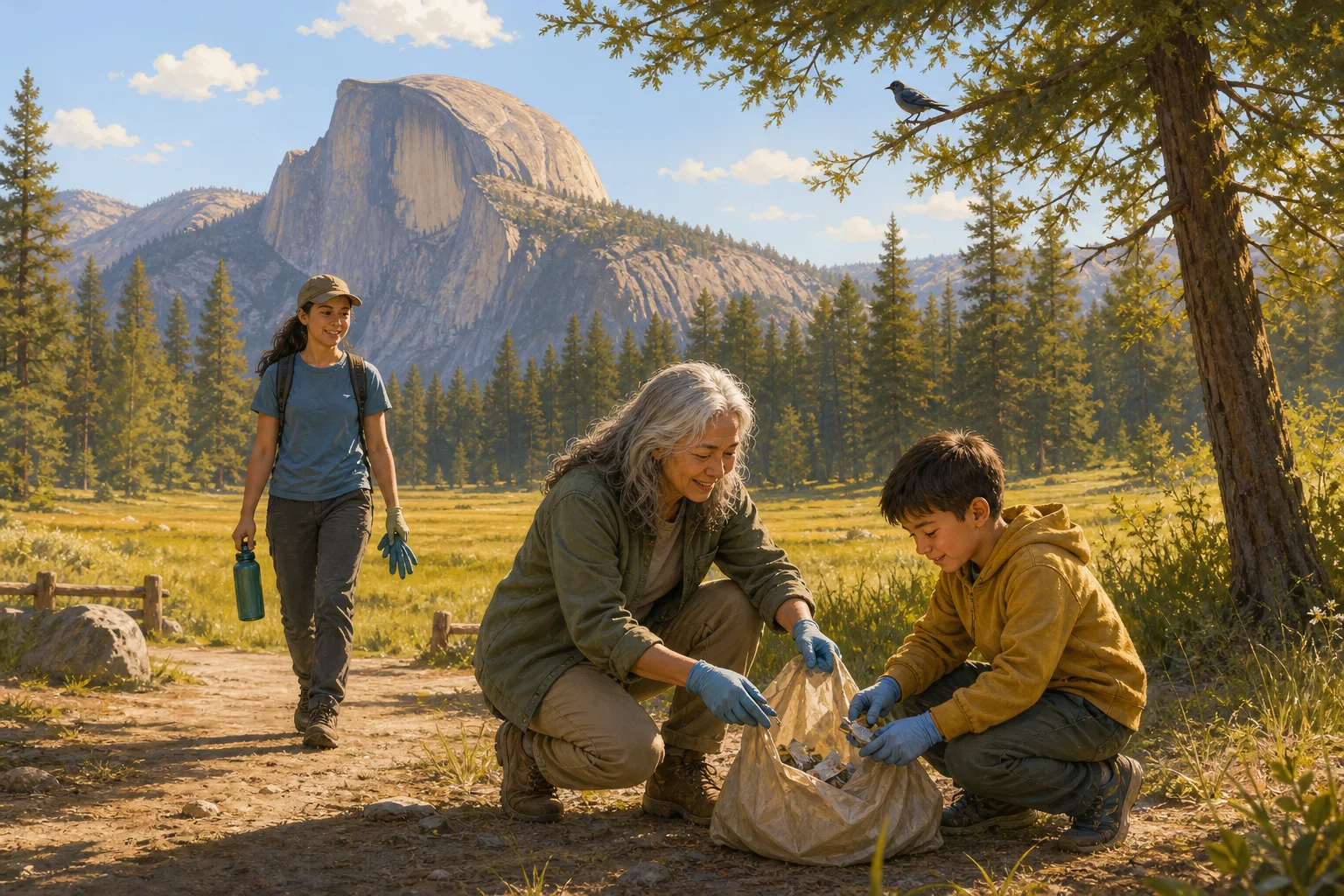
    Editorial illustration of an adult and a young volunteer collecting small pieces of litter beside a Yosemite Valley meadow, with Half Dome in the distance.
    Editorial illustration

    Before you go

    The National Park Service’s Yosemite drop-in volunteering page is the practical place to confirm the August 18 details and review what to bring. The broader Volunteer with Us guide has links for finding opportunities nationwide.

    For now, Yosemite’s invitation is refreshingly specific: meet at 10 a.m., bring water, wear sensible shoes, and lend a hand. In a valley known for enormous views, it is a small way to make a real difference.

    Sources: Yosemite National Park — Drop-in Volunteering and Special Events; National Park Service — Volunteer with Us.

  • A Kona Community Workday Invites Care for ʻAimakapā Fishpond

    A Kona Community Workday Invites Care for ʻAimakapā Fishpond

    Smile Across America

    On Hawaiʻi Island’s Kona Coast, a few hours of shared outdoor work are on the calendar for Thursday: the National Park Service is inviting volunteers to help care for ʻAimakapā Fishpond at Kaloko-Honokōhau National Historical Park.

    The park’s Mālama ʻAimakapā Community Workday is scheduled for August 13 from 8:30 a.m. to noon. The plan is simple and practical: a short, half-mile hike followed by invasive-species removal around the fishpond. The park says the workday is open to everyone who registers, with gloves available for people who need them.

    Editorial illustration of volunteers walking beside a Hawaiian coastal fishpond with hand tools.
    Editorial illustration

    A place where care has a long view

    ʻAimakapā is more than a scenic stop near Kailua-Kona. The National Park Service describes it as the largest natural pond and wetland system on Hawaiʻi Island’s Kona Coast, at about 30 acres. It is a loko puʻuone: a fishpond formed behind a sand berm, where freshwater and seawater mix through channels. Native Hawaiians modified the pond for aquaculture, which remained active into the 1950s.

    That layered history helps explain why a small community workday matters. NPS materials identify ʻAimakapā as a rare natural fishpond and wetland complex with cultural significance as well as habitat value. The park’s longer-term restoration plan includes invasive-species control, native-plant restoration, monitoring, and community involvement.

    Editorial illustration of gloved volunteers removing invasive vegetation along a coastal wetland edge.
    Editorial illustration

    For people who want to take part, the park asks participants to bring water, a hat, reef-safe sunscreen, hiking boots, and gloves if they have them; water shoes can be provided. The invitation is not dressed up as a grand gesture. It is an attainable morning of showing up, meeting neighbors, and helping protect a place whose water, plants, birds, and history are closely connected.

    Care that stays local

    Kaloko-Honokōhau regularly hosts workdays because volunteers help preserve both natural and cultural resources, according to the park. That is the quiet promise in the word mālama: care expressed through action. On this stretch of Kona coast, it can look like a pair of gloves, a patient walk, and a group willing to make room for the wetland to thrive.

    Editorial illustration of a calm Hawaiian coastal fishpond wetland with distant wading birds and lava rock.
    Editorial illustration

    How to join: Registration details and final instructions are available from Kaloko-Honokōhau National Historical Park’s volunteer page.

    Sources

  • Smile Across America: Free Summer Music Takes the Lawn at Saugus Iron Works Tonight

    Smile Across America: Free Summer Music Takes the Lawn at Saugus Iron Works Tonight

    Smile Across America is a warm drive through the real gatherings that give a place its lift. Tonight, that route stops in Saugus, Massachusetts, where a lawn at Saugus Iron Works National Historic Site is set to become an easygoing meeting place for neighbors, music and a summer evening outdoors.

    The National Park Service and Saugus Public Library have scheduled the Ditto Band for the site’s free Summer Concert Series on Wednesday, July 29. The concert is planned for 6 p.m. on the upper lawn at 244 Central Street, weather permitting. The park asks visitors to bring a chair or blanket.

    It is a small invitation with a generous shape: local musicians on the bill, a historic public place after regular daytime rhythms, and room for residents and visitors to settle in together. The National Park Service says the series is designed to celebrate Essex County musical talent and create evening opportunities for people to engage with the park.

    Two neighbors carrying folding chairs and blankets toward a historic brick building and a lawn gathering.
    Editorial illustration for a community summer concert gathering.

    A Wednesday evening tradition

    The Saugus series began July 1 and is scheduled to continue on Wednesdays through August 19. The library’s July newsletter also lists the Ditto Band for July 29, confirming the evening’s place on the eight-week lineup.

    For a family looking for a low-key outing, the practical details are straightforward: there is no concert fee, the venue is Saugus Iron Works National Historic Site, and the performance is listed for two hours. Because the event is outdoors, checking the park’s update before heading over is sensible if the weather looks uncertain.

    A small local band performing outdoors for neighbors seated on a lawn beside a historic brick building.
    Editorial illustration of neighbors gathering for live local music.

    The good part is being there

    Not every bright community story needs a finish line or a grand announcement. Sometimes it is a weekly date, a lawn, a borrowed chair and a reason to stay out a little longer. In Saugus tonight, the plan is simply to make space for that.

    Sources

  • Smile Across America: A Saturday Morning in the Smokies, One Picnic Table at a Time

    Smile Across America: A Saturday Morning in the Smokies, One Picnic Table at a Time

    Smile Across America is our warm minivan route through real communities and the small, practical ways people care for the places they share. We have not visited this event.

    On Saturday morning, a Tennessee picnic area is on the itinerary for a hands-on reset. Great Smoky Mountains National Park has scheduled its Smokies Service Days “Checkup Chimneys” volunteer event for July 25, from 9 a.m. to noon at Chimneys Picnic Area.

    Editorial illustration of volunteers caring for a mountain picnic area.
    Editorial illustration created by Smile News; it does not depict the event or its participants.

    The work list is admirably concrete: replace picnic-table boards, collect fallen tree debris, clear grills, and remove litter left after the July 4 holiday. The park says the date was moved from July 11 because of weather.

    A few hours, many useful details

    There is something especially cheering about the scale of a morning like this. No grand promise is required—just neighbors and visitors putting a few things back in working order, one table and grill at a time. The National Park Service describes the event as open to all ages and free to attend.

    Editorial illustration of volunteers repairing a wooden picnic table in a mountain grove.
    Editorial illustration created by Smile News; it is not documentary photography.

    Participation does require advance registration. Prospective volunteers are asked to contact the park’s volunteer coordinator, use “SMOKIES SERVICE DAYS” in the subject line, and include the date they want plus the number and ages of any youth volunteers. The park will send a confirmation if space is available, along with closer-to-the-date details.

    A welcome waiting in the woods

    By lunchtime, the payoff should be easy for the next family or group of friends to notice: a cleaner grill, a sturdier seat, a clearer corner of the picnic area. Those are humble improvements, but they are a kind of welcome—made by people who chose to leave a shared place more ready for the next person.

    Editorial illustration of a cared-for mountain picnic area with volunteers walking along a trail.
    Editorial illustration created by Smile News; it is an imagined scene.

    For registration and the latest logistics, use the National Park Service event listing rather than relying on this story.

    Sources

  • Smile Across America: Skagway’s Junior Ranger Day Invites Families to Make a Day of It

    Smile Across America: Skagway’s Junior Ranger Day Invites Families to Make a Day of It

    Smile Across America is our look at real, welcoming things happening in communities around the country. This is a preview based on the National Park Service announcement; Smile News has not attended the event.

    On the next stop of our imaginary minivan map, the road runs north to Skagway, Alaska, where Klondike Gold Rush National Historical Park is inviting families to a free Junior Ranger Day on Thursday, July 30.

    The park says the celebration will mix hands-on activities, live entertainment and a chance for visitors to earn a Junior Ranger badge. The plan includes performances by the Chilkat Dancers of Klukwan and Haines, a visit with live raptors from the American Bald Eagle Foundation, historic costumes, ice-cream making, an obstacle course and a live musical performance. The schedule also lists an appearance by Nuggets the Bear and a group Junior Ranger swearing-in ceremony.

    Editorial illustration of a family meeting a ranger in an Alaska gold-rush-era town with mountains behind them.
    Editorial illustration, created for Smile News. Editorial illustration.

    A day built for curious visitors

    For families, the appeal is less about checking off a list than having several easy ways to join in: meet park staff, try an activity, listen to music, watch a performance, or simply make a little room in the day for an Alaska history lesson with a side of ice cream.

    The National Park Service says the Junior Ranger Activity Center in the historic Pantheon building at Broadway and Fourth Avenue will also be open. Visitors can explore hands-on exhibits, talk with rangers and work through a Junior Ranger book there.

    Editorial illustration of children and caregivers exploring maps and nature objects with a park educator at a table.
    Editorial illustration, created for Smile News. Editorial illustration.

    Program Manager for Interpretation and Education Tyra Olstad said in the park’s announcement that Junior Rangers are among the park’s most enthusiastic visitors. The message behind the day is pleasantly simple: curiosity is welcome, and it is better with company.

    What to know before heading over

    The event is scheduled for Thursday, July 30, and the park says it is free and open to the public. A detailed schedule is expected to be available at the visitor center that day. Because event details can change, families should check the park’s official announcement before traveling.

    Editorial illustration of children taking a Junior Ranger oath with a ranger while caregivers stand nearby in an Alaska mountain setting.
    Editorial illustration, created for Smile News. Editorial illustration.

    Whether a young visitor comes away with a badge, a new question, or just a good story about the day, Skagway’s invitation is a generous one: show up, look closely and let a national park make room for play.

    Source

    National Park Service: “2026 Junior Ranger Day”, news release dated July 23, 2026.

  • Smile Across America: Glacier’s Native America Speaks Returns Tonight

    Smile Across America: Glacier’s Native America Speaks Returns Tonight

    Smile Across America is a look at real places and gatherings around the country. This article is based on public program information; Smile News did not attend the event.

    On Tuesday evening, a lobby near the Amtrak station in East Glacier Park, Montana, is scheduled to become a place for listening. Glacier National Park’s Native America Speaks program begins its summer run at Glacier Park Lodge at 7:30 p.m. The free, 45-minute gathering is listed as a weekly Tuesday program through September 8.

    Its appeal is refreshingly direct: members of the Blackfeet Nation and the Confederated Salish and Kootenai Tribes share personal knowledge of their history and culture. That means the people with the relationship to this place get to set the terms of what visitors can learn, rather than having the story filtered through a generic park script.

    A long-running invitation to listen

    Glacier says Native America Speaks began in 1982 and is the National Park Service’s longest-running Indigenous speaker series. The park describes presentations at campgrounds, historic lodges and other locations, while the series’ schedule offers a simple way to make cultural learning part of a summer visit.

    The lodge session is in the Glacier Park Lodge lobby, on Montana Highway 49 across from the East Glacier Park Amtrak station. The National Park Service lists it as free. Visitors should treat the posted time and location as the plan, and check the official listing before heading out in case a program detail changes.

    Editorial illustration of an anonymous traveler approaching a warmly lit mountain lodge at dusk.
    Editorial illustration; not a depiction of Glacier Park Lodge, the program, or its presenters.

    Why this is a Smile Across America stop

    “Smile” can mean a small civic kindness: making room for people to speak for themselves and making time to hear them. This program creates that opening in a place many travelers already pass through. There is no claim here that every visitor will leave with the same experience. The encouraging part is more concrete: a recurring public program places tribal voices at the center of a conversation about Glacier’s history and living cultural connections.

    The National Park Service notes that numerous Native American tribes used the area around and within what is now Glacier for hunting, fishing, ceremonies and gathering plants. Its visitor guidance encourages people visiting Glacier to hear from tribal members through Native America Speaks. That context matters: a good evening at a park is not just a scenic backdrop; it is an opportunity to listen with care.

    How to show up thoughtfully

    • Arrive early enough to find the lodge lobby without interrupting the start.
    • Listen first. Do not assume a presenter is speaking for every Indigenous person or community.
    • Ask before photographing or recording, and follow any request about phones or participation.
    • Use the park’s official Native America Speaks information page and event calendar for the latest schedule.
    Editorial illustration of a blank notebook, a mug and a mountain sketch on a lodge table.
    Editorial illustration; not a depiction of the event or its materials.

    For anyone in East Glacier on July 21, the route is uncomplicated: a free evening program, a public lodge lobby and a chance to hear community members share knowledge in their own words. It is a modest plan, but a meaningful kind of welcome—one that begins by making room to listen.

    Sources

  • Smile Across America: $25,000 Helps New Philadelphia Invite New Citizen Storytellers

    Smile Across America: $25,000 Helps New Philadelphia Invite New Citizen Storytellers

    Smile Across America is a series about real people and communities finding practical ways to make life a little brighter. This report is based on National Park Service announcements; the accompanying images are original editorial illustrations, not documentary photographs.

    In west-central Illinois, a new $25,000 grant is set to make room for a simple but powerful kind of community work: people telling their own local history.

    New Philadelphia National Historic Site has received support from the Jefferson National Parks Association’s BlueSky Opportunity Fund for an 18-month initiative called Our Past, Our Voices: Building Community through Citizen Storytelling at New Philadelphia. The National Park Service says the project will create Storytelling Stations that pair first-person historical vignettes with live, on-site and digital storytelling.

    A history that belongs in many voices

    New Philadelphia’s story has long been carried through records, oral histories, archaeology, descendants, and neighboring communities. The town was founded in 1836 by Free Frank McWorter, a formerly enslaved man; the National Park Service describes it as the first U.S. town platted and legally registered by an African American.

    That background gives the new program a particularly human scale. Rather than treating history as something visitors only read on a sign, the plan is to invite community members into monthly workshops where they can learn to present local stories for national audiences. The grant will also support paid internships in historical research and interpretive narrative development with Illinois College, the University of Illinois Springfield, and the New Philadelphia Association.

    Editorial illustration of two people comparing a historic town map and note cards at a workshop table.
    Editorial illustration; it does not depict an actual New Philadelphia workshop or participants.

    Listening is part of the plan

    There is no announcement yet of workshop dates or internship openings. The park says that information will be shared as the project develops. That is worth stating plainly: these are plans now, not programs the public can already attend.

    Still, the project offers a hopeful model. It connects historical research with the people who know a region, care for its memory, and want to pass it along. In a place whose legacy has been sustained by generations of people refusing to let it disappear, training new citizen storytellers is less a handoff than an invitation.

    Park superintendent Chris Collins said the project will strengthen the site’s ability to share New Philadelphia’s stories and that the park looks forward to working with students and community members. For readers following along from elsewhere, the small joy is in the premise: a national historic site is making space for local voices to be heard.

    Editorial illustration of a prairie storytelling station with visitors approaching along a path.
    Editorial illustration of the kind of welcoming public storytelling space described in the story; it is not an image of a planned or existing installation.

    Sources

  • Smile Across America: Yosemite’s Apple-Picking Day Is About Making More Room for Bears

    Smile Across America: Yosemite’s Apple-Picking Day Is About Making More Room for Bears

    Smile Across America is a place-led series about verified acts of care and community across the United States. This article is based on National Park Service information; Smile News did not attend Yosemite’s event.

    A small July volunteer job at Yosemite National Park carries a thoughtful purpose: pick apples before the fruit becomes an easy snack near busy visitor areas.

    The National Park Service scheduled its 2026 Apple Picking Day for July 15 in Yosemite Valley. The agency says the valley’s historic apple orchards can attract bears to non-native food, raising the chance of bear–visitor conflicts in nearby parking areas and campgrounds. Volunteers are invited to harvest the apples, helping remove that temptation.

    Editorial illustration of volunteers harvesting apples in a mountain orchard.
    Editorial illustration, generated for Smile News. It is not a documentary image of Yosemite’s event.

    A practical kind of welcome

    It is an especially approachable picture of stewardship: a few hours outside, a crate filling up with fruit, and a park made a little less likely to put people and wildlife in the same uncomfortable place. The work is not about feeding bears or getting close to them. It is about reducing an attractant before a bear has a reason to investigate a parking lot or campground.

    That distinction matters. The Park Service’s description points to a simple chain of cause and effect: apples ripen in historic orchards, bears are drawn to a calorie-rich non-native food source, and removing the fruit can lower the pull around areas where people are concentrated. The volunteer task is modest, but the aim is shared space with fewer risky surprises.

    Editorial illustration of gloved hands placing an apple into a wooden harvest crate.
    Editorial illustration, generated for Smile News. It does not depict a specific volunteer.

    One local tradition, many hands

    Yosemite lists Apple Picking Day alongside other drop-in volunteer opportunities, including seasonal litter cleanups and larger public-service events. For this particular day, the invitation is intentionally direct: come help take ripe apples out of the landscape that bears and people share.

    That makes the event feel like a tiny road-trip lesson from the valley. A volunteer does not need to solve every conservation challenge to take part in a useful one. Sometimes care looks like carrying a crate, working under an old fruit tree and leaving a familiar place a little easier for both its human visitors and its wild residents to navigate.

    Editorial illustration of volunteers carrying wooden crates toward apple trees on a sunny mountain path.
    Editorial illustration, generated for Smile News. It is a general visual interpretation, not a record of the event.

    What to take from it

    For anyone looking for a hopeful, concrete way to think about public lands, Yosemite’s apple-picking tradition offers one: good outcomes often begin with an ordinary task done together. The volunteers are not asked to manufacture a dramatic moment. They are asked to help make room.

    For current volunteer opportunities and event details, check Yosemite National Park’s drop-in volunteering and special events page before making plans. Dates and requirements can change.


    Source: National Park Service — Yosemite: Drop-in Volunteering and Special Events (page last updated July 6, 2026).